
- WILD LIFE Sydney Zoo, Daintree Rainforest
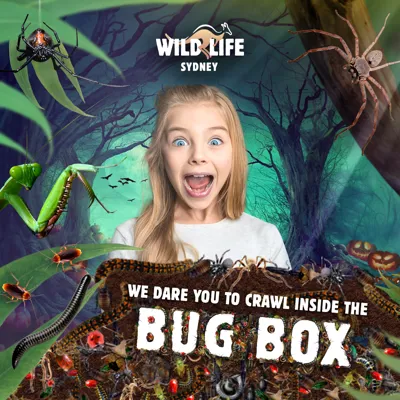
We dare you to crawl inside
Crawl inside Bug Box and discover a world of tiny, fascinating and often misunderstood creatures.
From clever survival skills to important roles in healthy ecosystems, we dare you to look a little closer and uncover the big impact of some of nature’s smallest animals.
Meet the Creatures

Rhinoceros Beetle

Bundaberg Banded Snail

St. Andrew’s Cross Spider

Australian Tarantula
Rhinoceros Beetle
Meet the mighty Rhinoceros Beetle! With its strong body and impressive horn, this little powerhouse is one of the most eye-catching insects you might spot in Bug Box.
Male Rhinoceros Beetles use their horns to compete with other males, but there is more to these beetles than their tough exterior. Beneath the surface, their larvae help break down decaying plant material, recycling nutrients back into the environment.
And here’s a WILD fact: Across Australia there are nearly 200 species of Rhinoceros beetle!

Built for battle
Male rhinoceros beetles use their horns to compete with other males.

Nature’s recyclers
Their larvae live in decaying organic matter, helping break down natural material.

They can fly!
Even with their heavy-looking bodies, rhinoceros beetles are capable of flight.
Bundaberg Banded Snail
Meet the Bundaberg Banded Snail, a small but seriously special creature with a beautifully patterned shell.
Found in parts of Queensland’s Bundaberg region, this land snail is known for its warm yellow-brown shell and darker banding. It can be found tucked away in sheltered spots such as under logs, rocks and pieces of timber.
It also has one of the quirkiest nicknames in Bug Box: the “suitcase snail”. Why? Scientists found a group of them living inside an old suitcase in vine thicket near Bargara. Talk about travelling in style!

Queensland local
This species is predominantly located in the Bundaberg region of South East Queensland.

Banded beauty
Their shells can range from tawny yellow to brown with darker brown banding.

Hidden forest helper
Land snails are important environmental indicators and part of the “hidden engine room” of forests.
Australian Tarantula
Meet the Australian Tarantula, one of the biggest and boldest spiders you might discover in Bug Box.
Also known as whistling spiders or barking spiders, Australian Tarantulas are ground-dwelling hunters with some seriously impressive survival skills. Females often live in silk-lined burrows, while younger spiders and males may shelter under rocks, logs or other hidden spaces.
Tarantulas usually feed on insects, other spiders and small animals such as lizards and frogs. They may look intimidating but look a little closer and you’ll discover an incredible Aussie arachnid with fuzzy legs built for life on the ground.

Burrow builders
Adult females live in web-lined burrows in the ground.

Grip masters
Thick hair pads on their legs and feet help them climb smooth surfaces.

Ambush expert
Rather than spinning webs to catch flying insects, they use stealth and speed to catch prey on the ground.
St Andrew’s Cross Spider
Discover the St Andrew’s Cross Spider, a skilled web-builder known for its striking stripes and distinctive web.
This unique spider gets its name from the bright cross-shaped silk pattern often found in the middle of its web. Females are the real showstoppers, with silver, yellow, red and black markings, while males are much smaller and more subtly coloured.
Commonly found in Australian gardens and if you look closely, you may spot one resting in the centre of its web, ready to catch flying insects. It is a patient hunter and a seriously fascinating arachnid.

Web designer
Its famous cross-shaped silk pattern is called a stabilimentum.

Garden hunter
These spiders catch flying insects including flies, moths, butterflies, bugs and bees.
Defensive moves
When threatened, they may drop from the web or shake the web rapidly to confuse predators.

General Admission
-
Peak pricing applies to school holidays and weekends.
Ticket Type Weekdays Weekends, School Holidays & Public Holidays On the day Advanced Adult $49.00 $39.00 $49.00 Child $36.00 $26.00 $36.00 Concession $39.00 $29.00 $39.00 Child (0-1 yrs) FREE Please note: Our ticket pricing is subject to available capacity and prices may fluctuate during periods of high demand.
Peak pricing includes school holidays in other Australian states.
- Price includes Digi Photo Pass with 8 digital photos included (excludes Koala Photo experience)!
- Children under 16 years of age must be accompanied by an adult (18+)
- Get your ticket on your phone
-
Ticket Type Weekdays Weekends, School Holidays & Public Holidays On the day Advanced Adult $49.00 $39.00 $49.00 Child $36.00 $26.00 $36.00 Concession $39.00 $29.00 $39.00 Child (0-1 yrs) FREE *All concession holders must have a valid concession/student/health care card to gain access to the attraction with a Student/Senior ticket.
Please note: Our ticket pricing is subject to available capacity and prices may fluctuate during periods of high demand.

Merlin Annual Pass
- 12 months of family fun at 8 top attractions in Australia and New Zealand
- Receive a great range of exclusive benefits and deals
- No blackout periods
- Pre-Booking is essential across all attractions
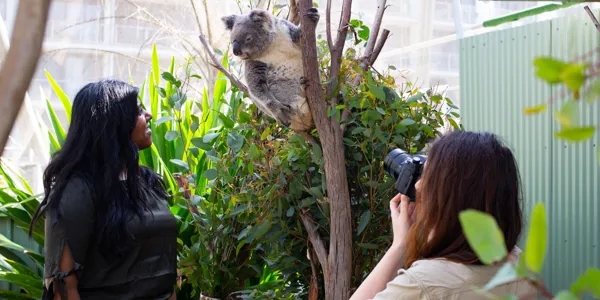
Koala Photo
- Please note: You will require a form of admission to use this experience
- A memorable photo opportunity
- Private session with a koala keeper inside the enclosure
- Get your ticket on your phone
- Book online to get the best deal

Breakfast with the Koalas
- Includes entry to WILD LIFE Sydney Zoo and a Koala Photo
- Enjoy a hot buffet breakfast served on the koala rooftop
- Free admission under age 2

Explore Daintree Rainforest
There is plenty more to discover in the Daintree Rainforest zone. After visiting Bug Box, continue your journey through this lush habitat and meet more of the amazing animals that help make Australia’s rainforests so unique.
FAQs
Bug Box is an exhibit where you can discover fascinating invertebrates, including beetles, snails, spiders and tarantulas.
Bug Box is designed as a viewing experience, giving you the chance to safely learn more about fascinating invertebrates. The creatures are cared for by specially trained keepers, who understand their unique needs, behaviours and habitats.
Invertebrates play essential roles in nature. They help recycle nutrients, support healthy habitats, control insect populations and form an important part of the food chain.
Bug Box can be found inside the Daintree Rainforest zone at WILD LIFE Sydney Zoo. Guests can explore it as part of their general admission visit.
