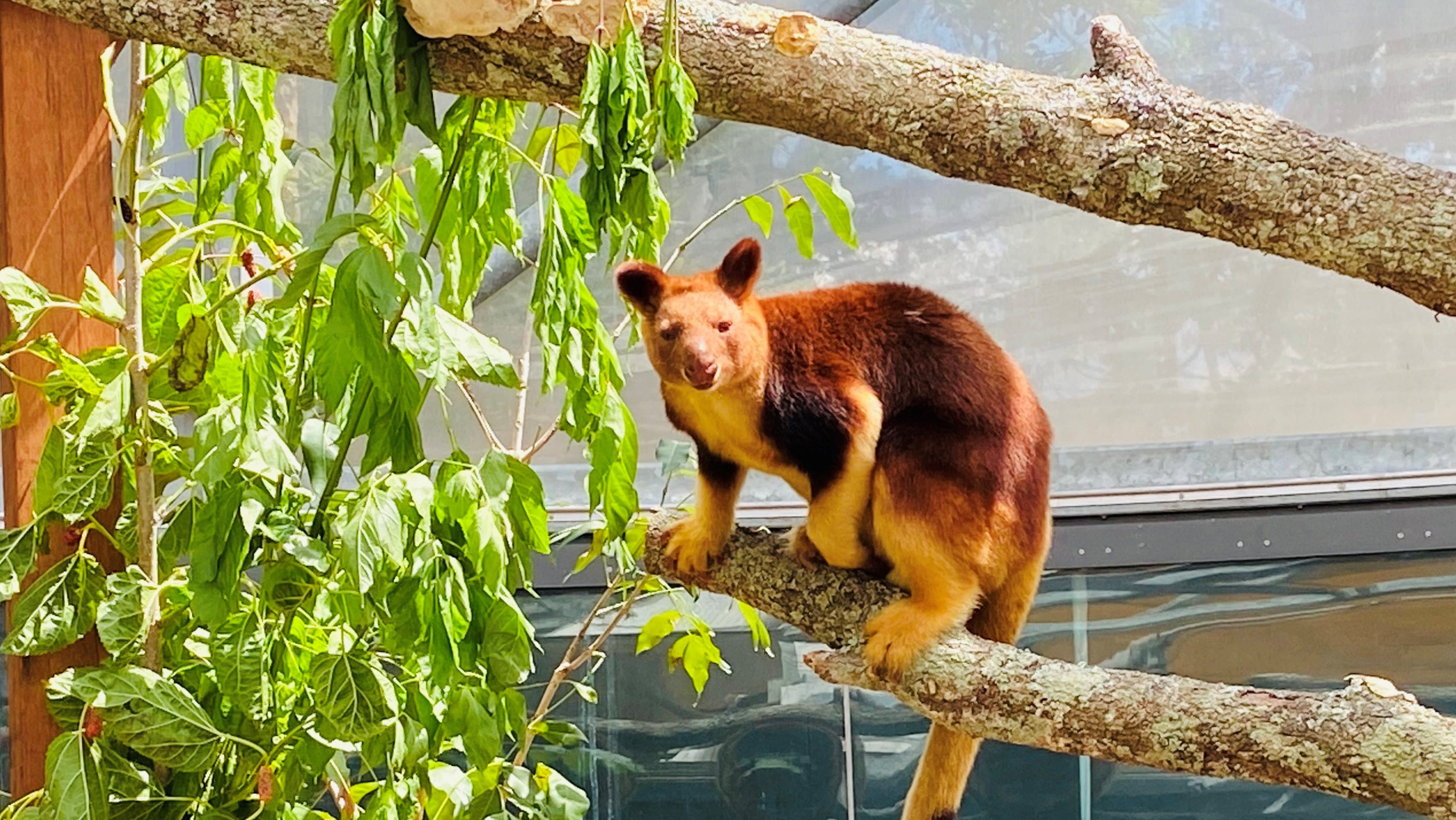

Meet Kofi
Dendrolagus goodfellowi
Meet Kofi, our much-loved Goodfellow’s Tree Kangaroo at WILD LIFE Sydney Zoo.
With his fluffy coat, bright blue eyes and impressive climbing skills, Kofi is always a favourite. Goodfellow’s Tree Kangaroos are native to the dense tropical rainforests of Papua New Guinea, where they are perfectly adapted to life high in the treetops.
These unique marsupials use their strong limbs, sharp claws and long tails to climb and balance through the forest canopy. They are herbivores, feeding on leaves, flowers and fruit. Although Kofi is also known to enjoy a boiled egg or two.
When you visit Kofi, you’ll discover more about Goodfellow’s Tree Kangaroos, the challenges they face in the wild, and why protecting rainforest habitats is so important.

General Admission
-
Peak pricing applies to school holidays and weekends.
Ticket Type Weekdays Weekends, School Holidays & Public Holidays On the day Advanced Adult $49.00 $39.00 $49.00 Child $36.00 $26.00 $36.00 Concession $39.00 $29.00 $39.00 Child (0-1 yrs) FREE Please note: Our ticket pricing is subject to available capacity and prices may fluctuate during periods of high demand.
Peak pricing includes school holidays in other Australian states.
- Price includes Digi Photo Pass with 8 digital photos included (excludes Koala Photo experience)!
- Children under 16 years of age must be accompanied by an adult (18+)
- Get your ticket on your phone
-
Ticket Type Weekdays Weekends, School Holidays & Public Holidays On the day Advanced Adult $49.00 $39.00 $49.00 Child $36.00 $26.00 $36.00 Concession $39.00 $29.00 $39.00 Child (0-1 yrs) FREE *All concession holders must have a valid concession/student/health care card to gain access to the attraction with a Student/Senior ticket.
Please note: Our ticket pricing is subject to available capacity and prices may fluctuate during periods of high demand.

2 Attraction Pass
- Visit SEA LIFE Sydney Aquarium within 60 days after visiting WILD LIFE
- Price includes Digi Photo Pass with 8 digital photos included!
-
Savings percentages are based on the maximum cost of purchasing individual entry tickets for each attraction when compared to purchasing a combo pass for the same date type (e.g. peak/off-peak, advance/on-the-day purchase).

Merlin Annual Pass
- 12 months of family fun at 8 top attractions in Australia and New Zealand
- Receive a great range of exclusive benefits and deals
- No blackout periods
- Pre-Booking is essential across all attractions
Fast Facts About Goodfellow’s Tree Kangaroos

Goodfellow’s Tree Kangaroos are marsupials
Like other kangaroos and wallabies, Goodfellow’s Tree Kangaroos are marsupials. Their joeys continue developing in their mother’s pouch after birth.

Tree kangaroos eat a plant-based diet
Goodfellow’s Tree Kangaroos mainly eat leaves, fruit, flowers and other plant material. At WILD LIFE Sydney Zoo, Kofi enjoys a carefully prepared diet suited to his needs.

Tree kangaroos are excellent climbers
Tree kangaroos spend much of their time above the forest floor, moving carefully through branches and using their tail for balance.

Goodfellow’s Tree Kangaroos are endangered
Goodfellow’s Tree Kangaroos are an endangered species, with habitat loss and hunting among the major threats they face in the wild.

IUCN Conservation Status
Endangered (EN)
Scientific Name
Dendrolagus goodfellowi.
Alternative Name
Ornate Tree Kangaroo.
Classification
Class: Mammalia
Order: Diprotodontia.
Family: Macropodidae, which also includes kangaroos and wallabies.
Genus: Dendrolagus
Identification and Size
Goodfellow’s Tree Kangaroos have soft reddish-brown fur, golden colouring on their face, limbs and underside, and two distinctive golden stripes along their back. Their long tail helps them balance, while their strong limbs and curved claws help them climb. Adults measure around 55-77cm in body length, with a 70-84.5cm tail and generally weigh between 5.9-9.5kg.
Habitat
They live in dense tropical forests, particularly lower and mid-mountain rainforest. The species has been recorded from lowland areas to elevations of around 2,860 metres.
Distribution
Goodfellow’s Tree Kangaroos are found on mainland Papua New Guinea, particularly along the country’s central mountain ranges from near the Indonesian border towards Milne Bay.
Feeding and Diet
Their diet is mainly made up of leaves, fruit, flowers and other plant material. They may also eat insects and occasional foods such as eggs.
Breeding
A female usually gives birth to one tiny joey. After birth, the joey climbs into its mother’s pouch, where it continues growing and developing for around eight to ten months.
Threats
Goodfellow’s Tree Kangaroos are threatened by hunting and the loss of their rainforest habitat. Forests are cleared or disturbed by logging, mining and agriculture, reducing the food, shelter and connected tree canopy they need to survive. Their slow breeding rate also makes it difficult for populations to recover from declines.
Conservation
The species is listed as Endangered. Conservation efforts are centred on protecting remaining rainforest habitat, reducing unsustainable hunting and limiting further land clearing. Maintaining large, connected areas of healthy forest benefits Goodfellow’s Tree Kangaroos and the many other species that share their habitat.

Who said it was rude to chew loudly? Not a tree kangaroo.
This May, Kofi is putting his crunching skills to the test for the International Tree Kangaroo Crunch-a-Thon!
Running from 11–15 May 2026, the Crunch-a-Thon brings together zoos and conservation organisations from around the world to celebrate one of the cutest tree kangaroo behaviours: munching, crunching and chewing very loudly. It all takes place in the lead-up to World Tree Kangaroo Day on 21 May.
At WILD LIFE Sydney Zoo, we’ve taken part in the Crunch-a-Thon before, and we’re excited to get behind it again with some very snackable content starring our Goodfellow’s Tree Kangaroo, Kofi.
Keep an eye on our social channels for Kofi enjoying his favourite crunchy snacks. Every like, share and view helps shine a spotlight on tree kangaroos and the importance of protecting these incredible animals in the wild.

Kofi takes on the 2024 Crunch-a-Thon
We all know it's rude to chew with your mouth open, but this doesn’t apply to Kofi!
#ASMR #TreeRooCrunchathon #SavingSpecies #TKSAFE
Goodfellow’s Tree Kangaroo FAQs
A Goodfellow’s Tree Kangaroo is a tree-dwelling marsupial adapted for life in the rainforest canopy.
Goodfellow’s Tree Kangaroos are native to the rainforests of Papua New Guinea. They spend much of their time in trees, where they climb, rest and search for food.
Yes, tree kangaroos are excellent climbers. They use their strong limbs, curved claws and long tail to move through branches and balance high above the ground.
Goodfellow’s Tree Kangaroos eat a plant-based diet made up of leaves, fruit, flowers and other vegetation. At WILD LIFE Sydney Zoo, Kofi is given a carefully managed diet.
Yes, Goodfellow’s Tree Kangaroos are endangered. In the wild, they face threats, making conservation awareness important for their future.
Tree kangaroos are an important part of their rainforest ecosystem. By learning about species like the Goodfellow’s Tree Kangaroo, you can better understand why protecting rainforest habitats is so important.
Yes, you can meet Kofi, WILD LIFE Sydney Zoo’s Goodfellow’s Tree Kangaroo, during your visit.
World Tree Kangaroo Day is held on 21 May each year. It raises awareness for tree kangaroos and the conservation efforts helping to protect them in the wild.
The International Tree Kangaroo Crunch-a-Thon is a social media campaign held in the lead-up to World Tree Kangaroo Day. Zoos and conservation organisations share short videos of tree kangaroos crunching, munching and chewing to help raise awareness for these incredible animals.

An adorable 7.3kg tree-climbing kangaroo moves to Sydney!
Meet Kofi, our first Goodfellow’s Tree Kangaroo - a 7.3kg fluffy, blue-eyed adorable creature with a fondness for climbing trees and boiled eggs.
Related blog posts
KOFI THE GOODFELLOW’S TREE KANGAROO IS A VERY GOOD BOY!
Meet Kofi – WILD LIFE Sydney Zoo’s first Goodfellow’s Tree Kangaroo and undoubtedly one of the most photogenic animals you will ever see!
Related blog posts
Join WILD LIFE Sydney Zoo in celebrating World Tree Kangaroo Day!
After two years and the support of zoos and conservation organizations all across the globe it is official - the Government of Papua New Guinea have declared World Tree Kangaroo Day as being the 21st of May each year to raise awareness on Tree Kangaroos and the unique biodiversity of PNG.
Related blog posts
The Goodfellow’s Tree Kangaroo
On May 21st, we celebrate World Tree Kangaroo Day. What are Tree Kangaroos and what is so special about these long-tailed tree dwellers?
Related blog posts- IUCN Red List of Threatened Species. Dendrolagus goodfellowi – Goodfellow’s Tree Kangaroo. Conservation status, population decline, geographic range and major threats, including hunting and habitat loss.
- American Society of Mammalogists. Mammal Diversity Database – Dendrolagus goodfellowi. Accepted scientific name, alternative common name, taxonomic classification, distribution and current species information.
- Animal Diversity Web. Dendrolagus goodfellowi – Goodfellow’s Tree Kangaroo. Information on physical identification, body and tail measurements, habitat, diet, behaviour, reproduction and climbing adaptations.
- Perth Zoo. Goodfellow’s Tree Kangaroo. Information on appearance, weight, climbing adaptations, feeding, reproduction, pouch development, distribution and threats.
- Tenkile Conservation Alliance. Goodfellow’s Tree Kangaroo. Information on identification, distribution, elevation range, diet, reproduction, pouch development and conservation status in Papua New Guinea.
- World Association of Zoos and Aquariums. Goodfellow’s Tree-Kangaroo. Information on population decline, habitat pressures, hunting, conservation breeding and the Global Species Management Plan for the species.
- Association of Zoos and Aquariums. SAFE Tree Kangaroo of Papua New Guinea. Information on collaborative conservation programs supporting Goodfellow’s and Matschie’s Tree Kangaroos and local communities in Papua New Guinea.
- United Nations Development Programme Papua New Guinea. Papua New Guinea Declares 21 May as World Tree Kangaroo Day. Information on the official recognition of World Tree Kangaroo Day and its role in raising awareness of tree kangaroo conservation.
- AZA SAFE: Tree Kangaroo of Papua New Guinea. International Tree Kangaroo Crunch-a-Thon. Campaign information, participation dates and conservation-awareness purpose.
- WILD LIFE Sydney Zoo Curatorial Team and animal management records. Kofi-specific information, including his appearance, personality, diet, weight, husbandry and individual history.
